All Categories
Featured
Table of Contents
Customer experience will not improve merely due to the fact that of a brand-new user interface if confusion still exists in the back workplace. In other words, each component either enhances the others or diminishes their value. That is why the method needs to cover all 4 locations simultaneously, even if execution occurs in phases. When transformation begins without a clear structure, focus is quickly lost: dozens of parallel initiatives emerge, none of which reach conclusion.
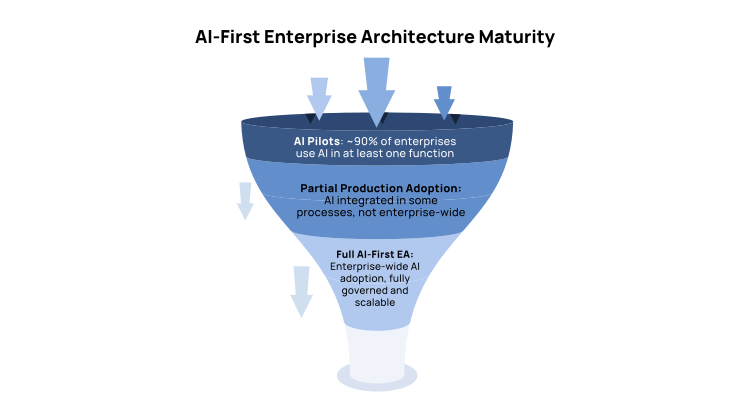
A digital improvement structure is a system of collaborates that allows handling change rather than merely reacting to issues. This framework must not be a universal template that works similarly well for a caf, an agricultural holding, and a global bank.
You need a sincere evaluation: where time is being wasted, where decisions are stalling, which processes depend upon a specific person. After that, you need to set particular, measurable goals. minimize the time to market for a new product from 4 months to 6 weeks; incorporate 80% of client queries into a single CRM; minimize the proportion of manual order processing from 40% to 5%.
Which initiatives are crucial, which can be delayed. Where the greatest impact lies, and where the highest risks are. It is necessary not to prepare whatever at the same time. It is much better to choose two or three focus areas and complete them completely than to spread efforts throughout ten directions and surface none.
When people comprehend what follows, it is simpler for them to support change. One of the most typical mistakes is beginning improvement with the selection of a platform. A strong structure operates in reverse: first come the goals and processes, and just then the tools. Technology must be an extension of business reasoning, not a separate world that only IT specialists inhabit.
Future Corporate R&D Trends for 2026
As a result, in practice these structures either do not work at all or lead in an entirely various direction than intended. A solid transformation structure should be versatile enough to adapt to truth, yet rigid adequate to prevent efforts from spreading uncontrollably. A great structure helps maintain focus, track development, and appropriate course when something fails.
They break down at the execution phase. A company might have an outstanding technique, leadership support, and a well-designed discussion. But once implementation starts, due dates slip, decision-makers prevent responsibility, and teams stress out. What emerges is not change, but an endless reorganization that everyone silently resents. To prevent this, execution ought to be treated as a consecutive process with clear phases, not as a "huge leap into the future." There is no universal dish.
It consists of 3 phases that can be adapted to your market, structure, and ambitions. At this phase, there are no brand-new interfaces, no fancy "before/after" slides, and no grand launches.
Leading High-Impact Digital Hubs in 2026
There is nothing even worse than moving fast without understanding where you are going. Key objectives of this phase: Not generic statements, but quantifiable expectations: what exactly ought to alter, which metrics will be affected, and which decisions will end up being faster, more affordable, or greater quality. For example: minimize time-to-market for brand-new items from six months to two; decrease churn amongst SME clients by 15%; automate 60% of internal requests.
It requires a devoted group with clearly specified functions, responsibilities, and resources. The improvement owner should have real decision-making authority. You can not develop a brand-new design without understanding how the old one works. This is where weak points surface area: manual Excel files, duplicated work in between departments, uncertain rules. IT must comprehend company objectives, and business needs to comprehend technical restraints.
This stage might feel slow or unproductive, but in reality it is an investment in the speed of subsequent stages. This is the stage where digital improvement relocations from idea to action or to turmoil, if priorities are set improperly. This is when the very first visible changes appear: systems go live, processes shift, and brand-new rules take impact.
Smart Infrastructure for Next-Gen Digital Success
The essential mistake at this stage is attempting to do whatever simultaneously: carry out ERP and CRM, automate logistics, upgrade the website, and re-train everybody concurrently. Instead of a digital advancement, the result is organizational paralysis. What to do instead: Select a couple of priority locations, bring them to quantifiable outcomes, analyze outcomes, lock in changes, and just then scale.
If the team does not comprehend why changes are occurring, quiet resistance will follow. Effective implementation is about managing gradual modifications in everyday routines.
Change is a brand-new operating model, and it only really works when it stops being perceived as something different or temporary. What matters at this stage: Not in general terms of "worked or didn't work," but alter by change: impact on speed, expenses, errors, sales, and consumer satisfaction.
If new rules are not working, they must be changed. If changes worked in one system, they can be scaled.
How to Scale Enterprise Hubs in Future?
This is the moment when digital modification stops being a task and becomes part of daily operations. This is where real tactical benefit starts. Business frequently approach us after they have currently begun transformation however got stuck along the method. On the surface, whatever appears like development, but internally there is consistent tension and no concrete results.
What to do: start with a concrete service diagnosis. Plainly define what should alter and how it will be measured.
Why Collaborative Tools Are Not a Replacement for Ecosystem Method
A CRM is purchased, analytics are established, a chatbot is launched which's it. The team continues to work as in the past, with no changes in culture, procedures, or management. In this case, brand-new tools end up being costly decors. What to do: even the very best system is worthless if the group does not understand how to utilize it daily.
Managing High-Impact Corporate Hubs in Transition
Teams working on change between other jobs rarely reach results. Obligation is theoretically shared by everyone, however in practice comes from no one. This causes endless discussions, delayed choices, and interdepartmental disputes. What to do: assign a dedicated group, resources, and time. This is a top-priority initiative, not an optional add-on.
The Development of Zero-Trust Models in Enterprise R&D How to Decrease Latency in Internationally Distributed Innovation Hubs Why Circular Style Is Winning the Infrastructure Race Accelerating DevelopAn organization can alter procedures, but if people do not trust the system, resist change, or continue working out of habit, failure is almost ensured. What to do: involve crucial people early. Describe the reasoning behind changes, guarantee transparent communication, and create an environment where it is safe to make errors, experiment, and adjust.

Latest Posts
Balancing Traditional Enterprise R&D and Modern Infrastructures
Distributed Computing As the Innovation Catalyst
Top Digital Cycles for Managing the Future